
When pushing harder isn’t the answer: redesigning leadership after burnout
You’ve poured thousands of hours into your business. You’ve carried the vision, absorbed the risk, and kept moving when others paused. And now—despite all of that—you feel exhausted. You can see what needs to change, but the team resists. The thought of “pushing through” again feels impossible.
Burnout isn’t weakness; it’s information. It’s your system telling you that the way you’ve been leading no longer fits the business you’ve built. This is the moment to redesign your leadership, restore energy, and build influence that doesn’t depend on you grinding harder.
Burnout is data, not a verdict
Founder burnout and change fatigue often arrive together. Long stretches of urgency, unclear decision rights, and constant context switching create chronic overload. When you keep driving change by personal effort—more meetings, more fixes, more late-night decisions—your energy becomes the limiting factor.
Burnout is a signal that your role and your operating system need an update.
Change resistance is rarely malice; it’s usually fear, fatigue, or a lack of clarity.
Momentum returns when you align how you lead with where the business is now—not where it was when you started.
This is not about stepping back from ambition. It’s about stepping into a different kind of influence—one that scales without burning you out.
Why people resist change (and why it’s not personal)
When leaders say “my team resists change,” here’s what’s typically underneath:
Ambiguity: People don’t understand the “why,” the “what,” or the trade-offs.
Loss of control: Change is done to them, not with them; autonomy feels threatened.
Competing priorities: Too many initiatives, not enough capacity.
Lack of trust: Past promises didn’t match reality; safety feels shaky.
None of that means the change is wrong. It means the change narrative, cadence, and decision design need attention. Your job isn’t to push harder—it’s to reduce friction, increase clarity, and create conditions where the change is the obvious next step.
From effort to influence: a practical
Below is the pivot I help founders make—moving from heroic effort to sustainable leadership and change readiness.
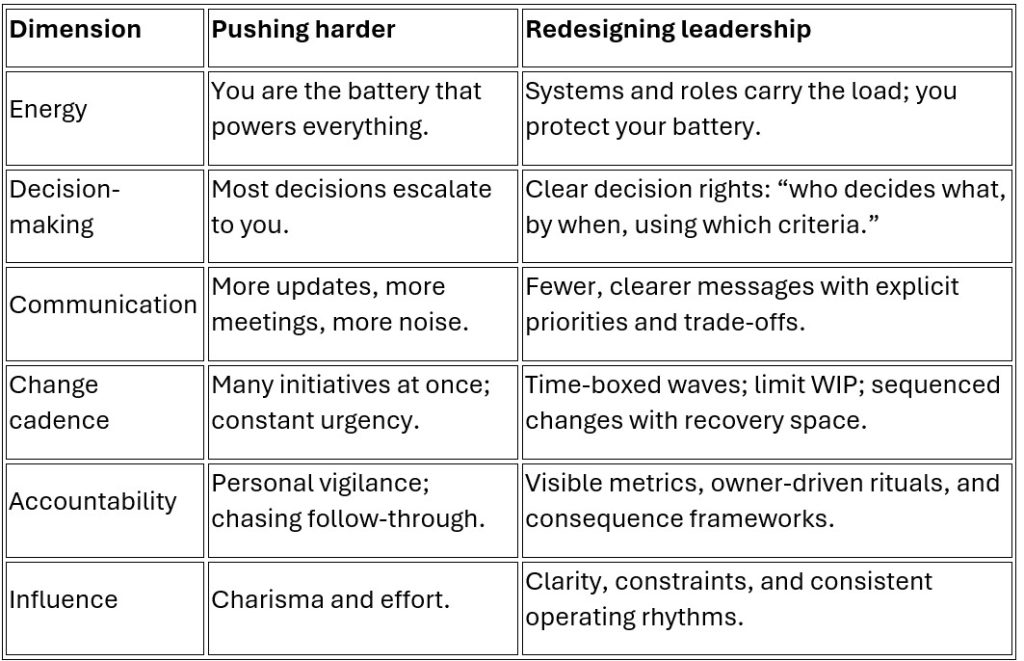
You don’t need to become less ambitious. You need to become more designed.
Three founder scenarios (and what changed)
Here are composites based on common patterns. If one sounds like you, pay attention to the lever that unlocked momentum.
SaaS founder (20-person team, stalled roadmap)
Pain: Feature creep, missed deadlines, founder rewriting specs at 11pm. Team “resists” pruning scope.
Redesign moves:
Introduced a 12-week delivery cadence; limited work-in-progress to three initiatives.
Clarified decision rights: Product Owner decides scope within performance constraints; CTO decides architecture.
Instituted a “Stop List” ritual to sunset low-value work weekly.
Result: Roadmap predictability improved; founder reclaimed 10 hours/week; resistance dropped when trade-offs became visible and consistent.
Services agency founder (15-person team, margin erosion)
Pain: Constant customisation for clients; team burnt out; founder doing “relationship rescues.”
Redesign moves:
Defined three standard offers with clear boundaries and price floors.
Empowered a Client Success Lead with authority to enforce scope and approve only two exceptions/month.
Shifted weekly meeting from updates to decision-making with pre-reads and options.
Result: Margin up 8 points; fewer emergencies; founder energy stabilised because the system protected focus.
Manufacturing founder (40-person team, quality issues)
Pain: Change to new supplier met with “that won’t work here.” Rework soared; morale fell.
Redesign moves:
Ran a pilot line with joint operator–engineering ownership; defined success metrics upfront.
Created a visible “quality wall” with defects and learnings; celebrated “caught early” signals.
Moved from consensus to consent: “We can live with it for now; we’ll review in two weeks.”
Result: Defects reduced 35% in six weeks; resistance softened when people saw fast feedback and real influence.
The theme: change becomes safer and simpler when decision rights, constraints, and cadences are explicit.
A quick diagnostic: where is the friction?
Use these prompts to locate the leverage points. Answer honestly.
Energy map: Which three activities drain you fastest? Which three consistently energise you?
Decision rights: For the last five “stuck” decisions, who owned them, and what was the decision rule?
Change load: How many significant initiatives are active right now? Which two could you pause without real harm?
Operating rhythm: Which meetings produce actual decisions? Which are status theatre?
Trust and safety: When did you last invite dissent early—and act on it?
Boundaries: Where are clients or stakeholders shaping your priorities more than your strategy is?
Signals: What are the top three leading indicators that your change is working (behavioural signals, not just output)?
If this stings a little, you’re close to the truth. That’s good. Clarity is kindness—to you and your team.
Redesign your role to restore energy and impact
Think of this as your role redesign sprint—fast, focused, and practical.
Reclaim decision energy
List your recurring decisions for two weeks.
Categorise: decide, delegate, design.
Decide: high-stakes, few per week, align to strategy.
Delegate: clear criteria + guardrails; let it go.
Design: build a rule or template so it doesn’t keep recurring.
Write decision rules: “If X and Y, then Z; else escalate.” Publish them.
Redraw your calendar around outcomes
Block two 90-minute deep work windows, three days a week.
Group meetings into two afternoons; protect mornings for thinking and design.
Replace weekly status meetings with owner-led written updates and a single decision forum.
Create constraints that liberate
Offer architecture: no bespoke unless it’s a strategic bet (limited to two per quarter).
Work-in-progress cap: never more than three active initiatives per team.
Stop List: kill something weekly; celebrate the deletion.
Upgrade communication from noise to clarity
Narrative: why this change, why now, what we’ll stop to make space, how we’ll know it’s working.
Cadence: predictable updates; same channel; same day; short and specific.
Two-way: explicit “where we want challenge” and how to offer it safely.
Build champions and early wins
Pick one squad where the change is most likely to succeed; run a time-boxed pilot.
Define three behaviours you expect to see within two weeks; measure only those.
Make success visible; let peers tell the story.
This is change management without the bureaucracy—lean, human, and transparent.
Influence more, without burning more
Founders often assume influence equals presence. In healthy organisations, influence equals design.
Clarity beats charisma: people follow clear rules faster than inspirational speeches.
Constraints create freedom: when the edges are known, teams move with confidence.
Cadence reduces anxiety: predictable rhythms lower the cognitive tax of change.
Consent over consensus: you don’t need everyone to love it; you need them willing to try it for a period.
Celebrate deletion: stopping low-value work is a leadership act; make it visible and normal.
When these are in place, change resistance fades because you’ve removed the reasons to resist.
Common traps to avoid
Announcing everything, pausing nothing: If everything is a priority, nothing is. Always pair a start with a stop.
Delegating outcomes without decision rights: “Own this, but ask me before you decide” guarantees stall-outs.
Too many pilots with no consolidation: Run fewer, finish them, and scale what works.
Measuring only outputs: Track behavioural signals and decision speed, not just delivery.
Using your calendar as a to-do list: It’s a strategy instrument—shape it to reflect the role you need to play now.
How to know it’s working
Pick a short time horizon—six to eight weeks—and track these simple, telling signals:
Founder energy: a weekly self-score out of 10; aim for +2 within six weeks.
Decision throughput: count stuck decisions; aim for a 50% reduction.
Work-in-progress: fewer initiatives in flight; faster cycle time.
Adoption behaviours: the three behaviours you defined—are they happening unprompted?
Stop rate: how many tasks or projects did you intentionally stop?
Sentiment snippets: short, anonymous pulse (“Today, change feels: clear / confusing; safe / risky; urgent / performative”).
Small signals compound. Momentum is a leading indicator; results follow.
If you’re reading this and thinking “this is me”
Good. That awareness is rare—and it’s the doorway out of burnout.
Here’s a low-friction way to start:
Choose one team.
Define one change.
Set one constraint.
Run one two-week pilot.
Make one decision rule visible.
Stop one thing to make space.
Tell one clear story about why it matters.
Then, review what you learned. Keep the parts that reduced friction and restored energy. Repeat.
If you want a clearer mirror, I’ve built concise diagnostic prompts and change readiness tools for founders who need to regain agency without adding more meetings to their week. They’re short, sharp, and practical—and they meet you where you are.
Final thought
You don’t need another heroic sprint. You need a different design for your leadership and your operating system. Burnout is not a verdict—it’s a constraint. And constraints, used well, are how great businesses scale without breaking their leaders.
If you’re ready to redesign your role, reduce resistance to change, and rebuild sustainable momentum, reach out. Let’s make your leadership lighter, your influence stronger, and your impact more enjoyable.
.