
A group of Australian healthcare professionals felt overwhelmed by constant change. Their teams were also burnt out, questioning their ability to continue in the industry. Here’s how we helped them.
Diagnosis: Change Fitness Assessment
We could see the obvious problems: constant change, feeling overwhelmed, inner doubts about the capacity to continue. But what we couldn’t see was how change-fit the people were. Change fitness enables repeatable, scalable transformations without burnout. That’s what we needed to test first.
Purpose: To measure psychological endurance for change.
Findings:
Motivation and Vision were notably weak.
All scores were below 50%, indicating change aversion and impaired performance under pressure.
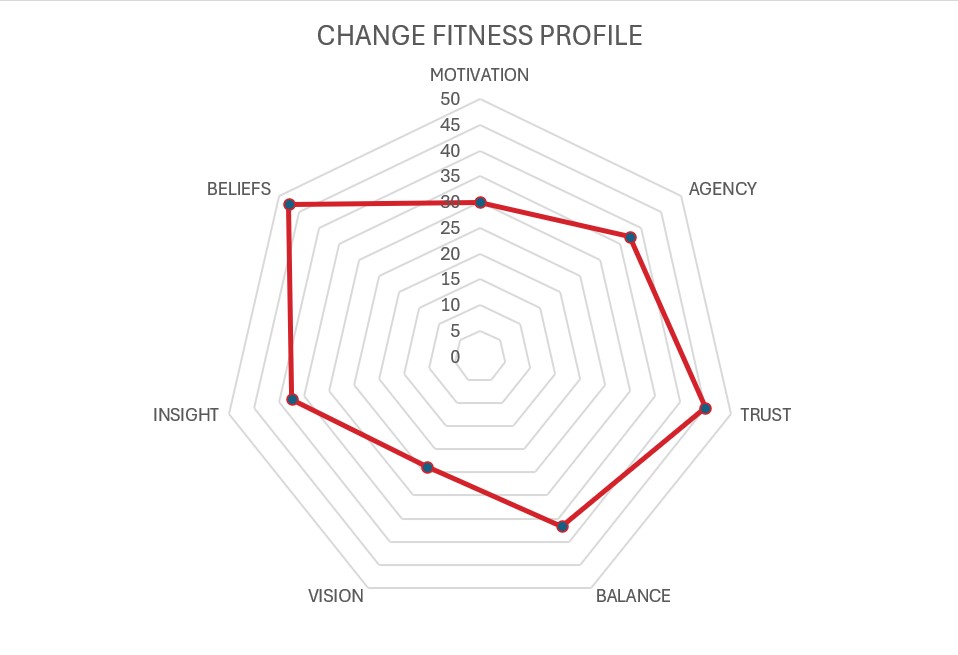
This is what their change fitness scores looked like. Motivation and vision are weaker than the other areas. This in itself would make it hard for them to cope with change.
And look at the numbers – they are all below 50. That tells a story. This is a group of people who are change-averse and whose workplace performance is adversely affected when significant change occurs.
Intervention: Personal Change Fitness Program
We gave the group feedback on their change fitness profile and suggested that some specific coaching would help. They agreed, and we enrolled them in the Personal Change Fitness Program.
Approach:
Individual and group coaching for 12 weeks.
Exploration of beliefs and thinking patterns around change.
Alignment with academic theory to challenge unhelpful assumptions.
Outcome:
Motivation and Vision improved.
Average score rose from 39% to 58%.
Most scores exceeded 50%, with four in the 60s.
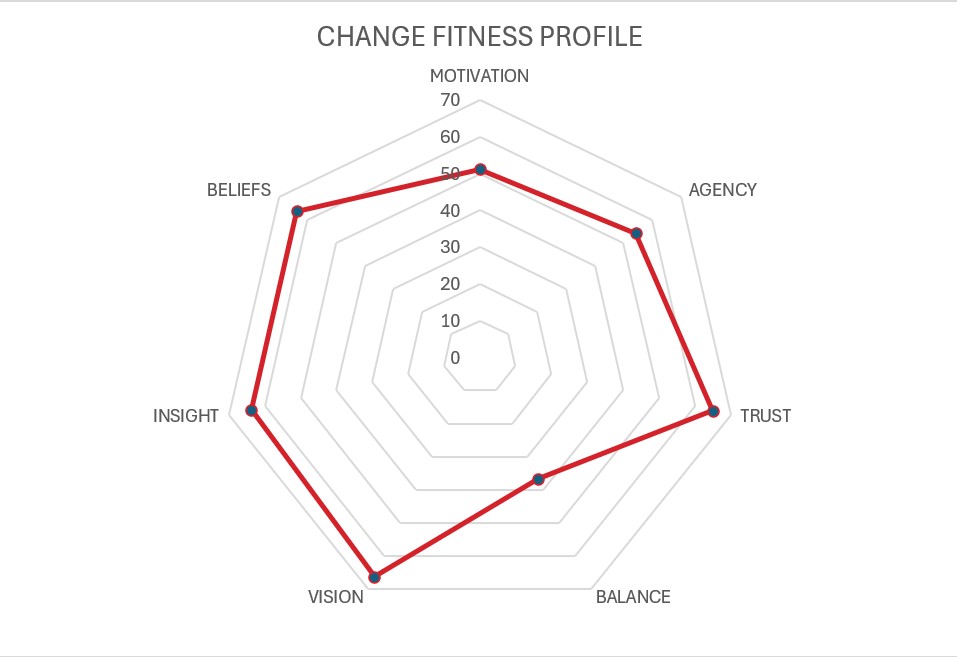
After the coaching sessions, motivation and vision had both improved. It’s not yet perfect – but it is a distinct improvement.
Also note the numbers. Before coaching, the group’s change fitness score averaged 39% and none of the scores even reached 50. Now, the average scores are 58%, with four of the seven scores falling within the 60 range, and all but one exceeding 50.
How did this change the people? They shifted from fear and reluctance to a more emboldened and forward-looking mindset.
Theory Behind the Practice
Core Idea: The pressure of constant change in the modern world is not the problem – it is simply the reality of modern life. The problem is the lack of change fitness. Change fitness builds inner psychological strength, not just any strength, but change strength and endurance. This is where the theory of change readiness becomes critical. By the way, a theory is not a guess. It is an evidence-based explanation of how things work.
Broader Strategy: We went on to discuss how change fitness could be aligned with other organisational structures (like leadership, culture, process) so change readiness has a much broader footprint.
Benefits of Building Change Readiness
Faster execution of change projects
Stronger, adaptive culture
Quicker adoption rates
Competitive edge and talent retention
Reduced risk and improved performance