
What is Readiness‑Centred Change™?
Readiness‑Centred Change™ is a structural approach to organisational change, the culmination of more than 20 years of research, modelling, and field application across individual, cultural, structural, and behavioural domains. It focuses on the conditions that allow change to land, stabilise, and stick — before communication or engagement begins.
A New Architecture for Change
Most change methodologies focus on communication, engagement, and adoption planning. These tools are valuable — but they assume the organisation is ready to receive change.
In reality, many organisations are:
overloaded
ambiguous
structurally inconsistent
drifting
unclear on priorities
operating with fragile routines
In these conditions, even well‑designed change initiatives fail.
Readiness‑Centred Change™ is a structural approach that focuses on the conditions that allow change to land, stabilise, and stick. It shifts the practitioner’s attention from managing people to shaping the system.
What Makes This Different
| Traditional Change Management | Readiness‑Centred Change™ |
|---|---|
| Engagement-led | Structure-led |
| Behaviour-first | System-first |
| Reactive | Engineered |
| Relational trust | Structural trust |
| Adoption planning | Capacity modelling |
| Resistance as cause | Resistance as symptom |
| Change as event | Change as capability |
Why Readiness Matters
Change doesn’t fail because people resist. It fails because the system cannot carry the load. Readiness‑Centred Change™ recognises that: people have limited cognitive bandwidth systems have limited structural capacity load, ambiguity, and inconsistency erode readiness trust collapses when the system behaves unpredictably drift increases when routines are unstable change cannot succeed in an overloaded environment Readiness is not a mindset. It is a structural condition.
The Structural Forces Behind Readiness
Readiness‑Centred Change™ is grounded in physics‑aligned principles that explain how systems behave under pressure. These forces include:
Load
Too much load slows everything down and reduces capacity for change.
Friction
Small inefficiencies multiply under pressure and block flow.
Flow
Work moves best through clear, predictable pathways.
Resistance
Systems push back when force is applied too quickly or without stability.
Drift
Systems naturally move out of alignment unless corrected early.
Structural Integrity
Weak architecture collapses under the weight of change.
When practitioners understand these forces, behaviour stops looking mysterious. It becomes predictable — and fixable.

Structural Trust: The Foundation of Readiness
Trust is often treated as an emotional or relational issue. In organisations, trust is structural.
People trust systems when:
decisions are predictable
priorities are stable
expectations are clear
leaders behave consistently
load is manageable
Trust collapses when these conditions weaken — even if relationships are good.
Readiness‑Centred Change™ gives practitioners tools to engineer trust through structural integrity, not motivational tactics.
Decision Pathways: The Hidden Architecture of Change
Most organisations don’t have decision systems — they have decision chaos. When decision pathways are unclear: work slows priorities drift accountability blurs trust erodes readiness collapses Readiness‑Centred Change™ helps practitioners map, stabilise, and clarify decision pathways so change can move through the system without friction.
How Readiness‑Centred Change™ Complements Existing Methodologies
This approach does not replace traditional change management. It strengthens it.
Practitioners can integrate readiness principles into:
Prosci / ADKAR
Kotter
Agile change
Lean change
Human‑centred design
Internal change frameworks
Readiness‑Centred Change™ provides the structural foundation that makes these methodologies more effective.
What Practitioners Can Do with This Approach
A readiness‑centred practitioner can:
diagnose structural barriers before change begins
reduce load to create capacity
stabilise routines so change has somewhere to land
correct drift early
build structural trust
clarify decision pathways
design readiness pathways for teams and leaders
support leaders to create coherent conditions
This is a deeper, more accurate way to understand organisational behaviour.
The Readiness Engine™
Readiness‑Centred Change™ is supported by the Readiness Engine™, a structured framework that integrates:
readiness diagnostics
load analysis
drift detection
structural trust mapping
decision pathway clarity
capability architecture
readiness pathways
This engine helps practitioners design and deliver change that is structurally supported, not just communicated.
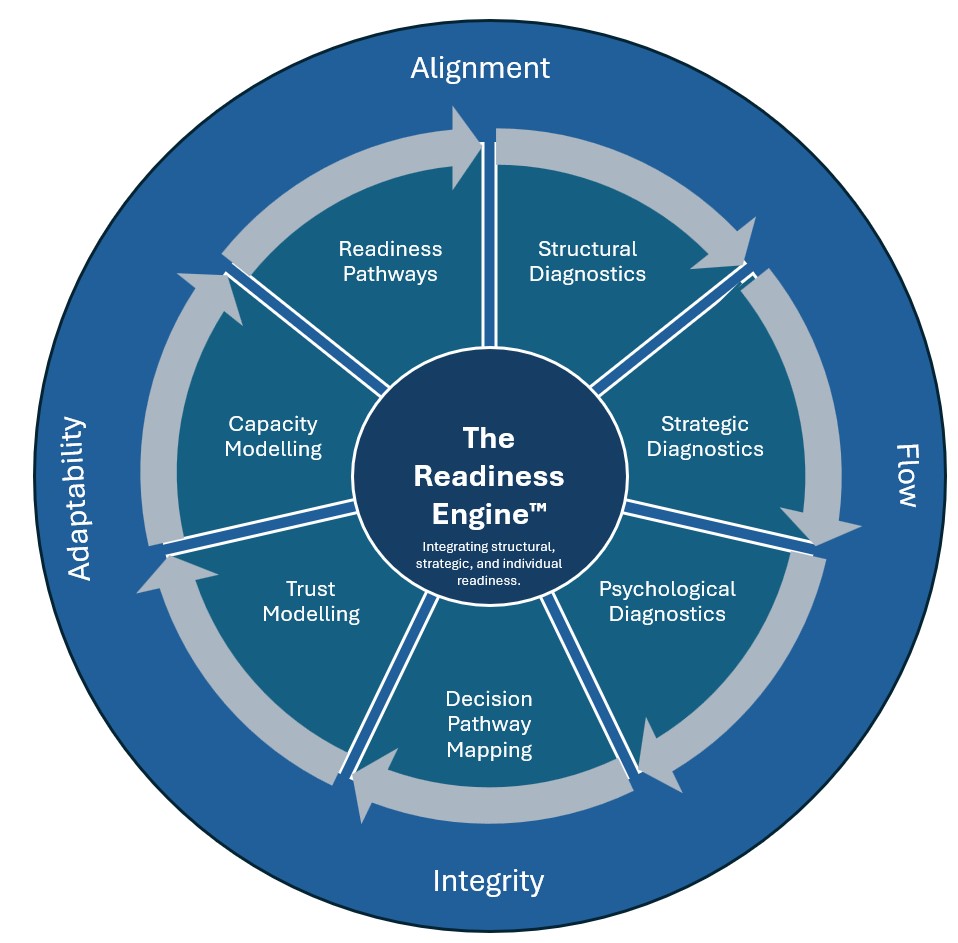
The Readiness Engine™ integrates structural, strategic, and individual readiness into a single, coherent system. It gives leaders and practitioners a way to diagnose misalignment, stabilise trust, engineer decision pathways, and design readiness pathways that build capacity over time. This is the operating system behind Readiness‑Centred Change™.
Who This Approach Is For
Readiness‑Centred Change™ is designed for: change management practitioners organisational development consultants transformation leads internal change teams coaches and facilitators leaders responsible for complex change If you’ve ever felt that traditional change tools don’t fully explain what’s happening in the system, this framework gives you the missing architecture.
Learn More
If you want to explore Readiness‑Centred Change™ in more depth, you can:
Download the Whitepaper
Join the practitioner interest list
Explore readiness tools and diagnostics
This is the next evolution of change practice — grounded in structure, aligned with human capacity, and built for real‑world complexity.